|
 |
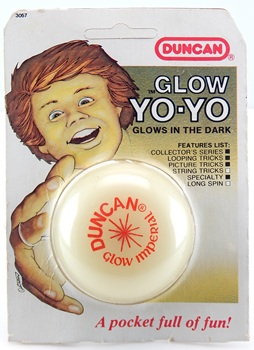
| Duncan Glow Imperial 1982 |
| Exhibit #5194 |
 |
|
| Type | Production |
| Shape | Standard (-) |
| Axle | Fixed |
| Color | Glow in the dark |
| Packaging | Bubble Carded |
| Construction | Multi-piece plastic |
| Response | Starburst |
| Gap | Fixed |
| Condition | Mint |
| Date | 1982 |
| Owner | Rick Brough |
| Compare |  |
|
|
The Duncan Glow Imperial yo-yo had a plastic body and a fixed steel axle. It came in 1982 packaging that showed a wide-eyed child, illustrated by Ostrom, lit by the yo-yo's glow and reaching toward it with his right hand.
The feature list on the front of the packaging had the following checkboxes marked:
• Collector's Series
• Looping Tricks
• Picture Tricks
• Specialty
Original retail price: $3 US.
How do you make a plastic glowing yo-yo?
To make a plastic yo-yo glow, manufacturers typically incorporate phosphorescent materials into the plastic using the following process:
1. Phosphorescent pigments: The key to glow-in-the-dark yo-yos is the use of phosphorescent pigments, such as zinc sulfide or strontium aluminate. These pigments absorb light energy and then slowly release it, creating a glowing effect.
2. Mixing with Plastic Resin: The phosphorescent pigments are mixed with clear or translucent plastic resin. This mixture ensures that the entire yo-yo will glow uniformly when exposed to light.
3. Molding: The plastic resin containing the phosphorescent pigments is then injected into molds to form the yo-yo's body. This process is similar to how regular plastic yo-yos are made, but with the added step of incorporating the glow-in-the-dark material.
4. Charging: After the yo-yo is made, it needs to be "charged" by exposing it to a light source. The pigments absorb the light energy, which they later emit in the dark.
Of interest...
To see all glow in the dark yo-yos, yo-yo parts, and yo-yo accessories in this museum, click here. | |
| |
|
 |
|
|
|
|
|
|
|
|
 |
|