|
 |
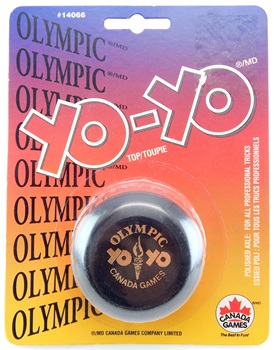
| Canada Games Olympic |
| Exhibit #5225 |
 |
|
| Type | Production |
| Shape | Standard (-) |
| Axle | Fixed |
| Finish | Painted |
| Color | Black |
| Packaging | Bubble Carded |
| Construction | One piece wood |
| Response | None |
| Gap | Fixed |
| Condition | Mint |
| Date | 1986 |
| Owner | Rick Brough |
| Compare |  |
|
|
The Duncan "Imperial" is an iconic symbol of yo-yoing in the United States, and in Canada, the equivalent was the classic Elfverson "Olympic" yo-yo and its "Pro" model counterpart. These one-piece wooden yo-yos were often a Canadian player's first introduction to yo-yoing, thanks to their widespread popularity. Originally manufactured by Elfverson in Sweden between 1968 and 2005, these yo-yos retained their signature body shape over the decades, despite occasional updates to the stamped seal. Canada Games Company, a Canadian toy manufacturer, played a significant role in the Olympic and Pro yo-yo's success, selling approximately 1.5 million units between 1986 and 1995. These yo-yos were also sold under other toy company names, such as National, Parker, Playtoy, and Irwin Toys.
Canada Games, founded in 1983 in Brampton, Ontario, produced a wide range of toys, board games, and puzzles. Their products often included tie-ins with popular movies and television shows, but they were best known for their pogs, which became a cultural phenomenon in the 1990s. The company also supported yo-yo enthusiasts with string packs, trick books, and their official guide, which detailed over 40 tricks, yo-yo history, champion tips, and information on joining the "Fun and Games Club." Despite their contributions to Canadian toy culture, Canada Games ceased operations in 1997, after 14 years in business. The closure was particularly untimely, as it coincided with a global resurgence in yo-yo popularity, especially in the U.S. and Japan. | |
| |
|
 |
|
|
|
|
|
|
|
|
 |
|